Thirty thousand four hundred. That is how many machinist and tool and die maker openings the Bureau of Labor Statistics projects each year through 2035. The number that matters sits in the next line of the same table. All of those openings come from replacement.
Not one is growth. Every opening exists because somebody moved to another occupation or left the workforce.
The machine tool technician shortage is usually described as a hiring problem. Replacement-only demand points at something narrower and harder. Machining is not an expanding trade. Roughly 30,400 seats a year have to be refilled just to hold it level, against a base of 344,900.
Overall employment in the category is projected to fall 1 percent between 2025 and 2035.
Where the decline concentrates
Tool and die makers carry the steepest decline. BLS puts that occupation at 56,700 jobs in 2025 and 51,500 in 2035, a drop of 9 percent. Machinists hold roughly flat, up 1 percent.
Read those two lines together and a pattern shows up. The decline concentrates in the work that takes longest to learn.
The category running the other way
A second BLS category runs the opposite direction, and most shops never look at it.
Industrial machinery mechanics, machinery maintenance workers, and millwrights held 547,300 jobs in 2025. BLS projects that group to grow 14 percent by 2035, much faster than the average for all occupations. Industrial machinery mechanics alone are projected up 18 percent, from 446,900 to 526,600. Median pay was $64,100 in May 2025.
These are the people who keep equipment running rather than the people who cut parts on it. Demand for them is climbing while the machining trade shrinks.
BLS ties that growth to the continued adoption of automated manufacturing machinery, which needs people to keep it in working order. The more automation content a shop specifies, the more maintenance skill that shop has to reach.
Wording in the two BLS entries is worth noticing. For machinists, all openings come from replacement. Among mechanics, many do. One category is being backfilled. The other is being backfilled and expanded at once.
Two curves, crossing. The same regional labor pool feeds both.
What it looks like on your floor
For a shop, the practical effect shows up in two places. Internal maintenance capability thins as experienced hands retire. External service demand rises at the same time, which lengthens the queue for anyone who does this work for a living.
Neither trend announces itself. Both show up as a longer wait the next time a spindle starts making noise.
Four unglamorous things that buy time
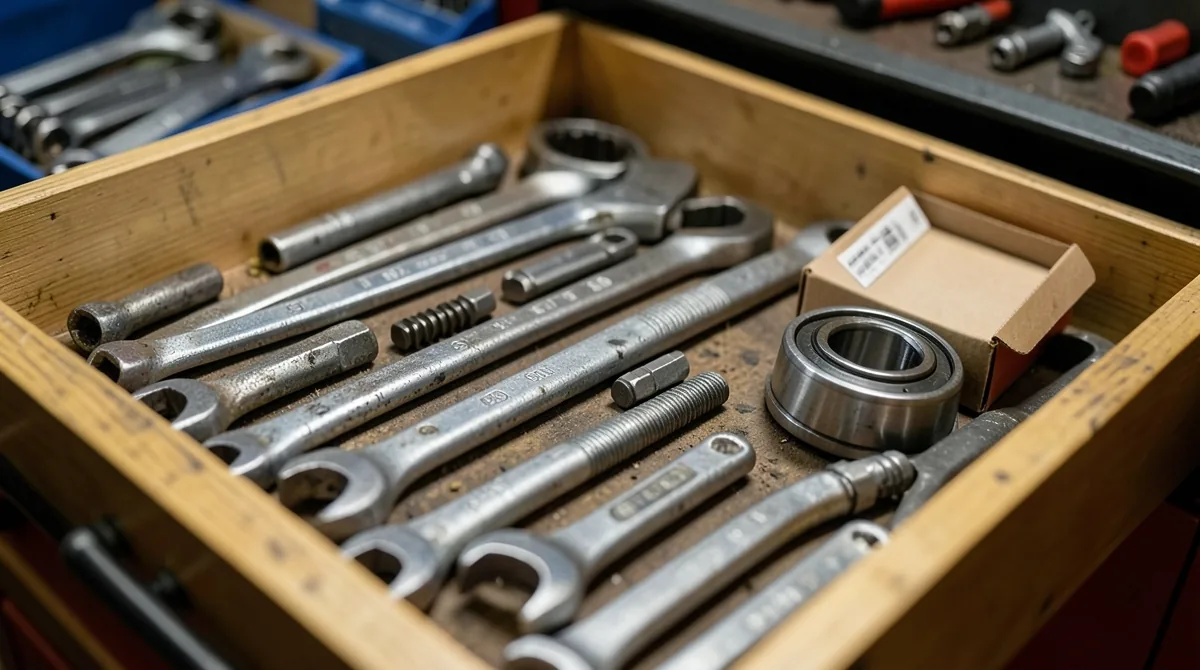
Shops handling this well tend to do four unglamorous things.
They write down what the veteran knows. Machine quirks, parameter backups, alignment history, which fixture goes with which program. That knowledge currently lives in one person’s head and leaves when they do.
They schedule maintenance rather than react to it. Planned downtime uses fewer technician hours than a breakdown, and it can be booked against a calendar rather than against an emergency.
They cross-train before they need to. Operators who can run a ballbar check or read a spindle temperature trend catch problems earlier, and the skill stays in the building.
They build a pipeline rather than shopping for one. Registered Apprenticeship pairs paid on-the-job training with classroom instruction, and the Department of Labor opened applications in January 2026 for an incentive fund paying eligible sponsors $3,500 for each new apprentice hired in advanced manufacturing.
Entry paths are shorter than most shop owners assume. BLS reports that industrial machinery mechanics typically need a high school diploma plus a year or more of training, and most millwrights learn through a three or four year apprenticeship.
None of that solves a shortage. All of it buys time against one.
Put technician lead time in the production plan
There is a planning point buried in the numbers that deserves its own sentence. The lead time on a qualified technician now belongs in production planning next to the lead time on a machine. Shops already track delivery dates on capital equipment. Very few track how far out their service provider is booked, and in a market where the trade is shrinking, that figure moves.
The capital equipment side of this is covered in our piece on record machine tool orders in 2026. When aging equipment forces a decision, the evaluation framework sits in our look at rebuilding, retrofitting, or replacing an aging CNC machine.
Two Ways Exact Machine Service Covers the Gap
Exact Machine Service has worked in York, Pennsylvania for more than 20 years, selling and servicing machine tools and placing technical people into manufacturing operations. The shortage question reaches the company from both directions.
Where shops usually start:
- Staffing Solutions — Placement of CNC and machine tool field service engineers, automation and robotics engineers, machinists, CNC programmers, and quality, mechanical, and electrical technicians
- Machine Tool Services — Field repair, inspection, calibration and laser alignment, and scheduled maintenance when the work needs to come from outside
Short a person, or short a service slot? Tell us which gap you are covering and what your equipment list looks like.
Works Cited
- United States, Bureau of Labor Statistics. “Machinists and Tool and Die Makers.” Occupational Outlook Handbook, 27 Aug. 2026.
- United States, Bureau of Labor Statistics. “Industrial Machinery Mechanics, Machinery Maintenance Workers, and Millwrights.” Occupational Outlook Handbook, 27 Aug. 2026.
- United States, Department of Labor. “US Department Labor, Arkansas Announce American Manufacturing Apprenticeship Incentive Fund Portal Now Accepting Applications.” DOL Newsroom, 28 Jan. 2026.