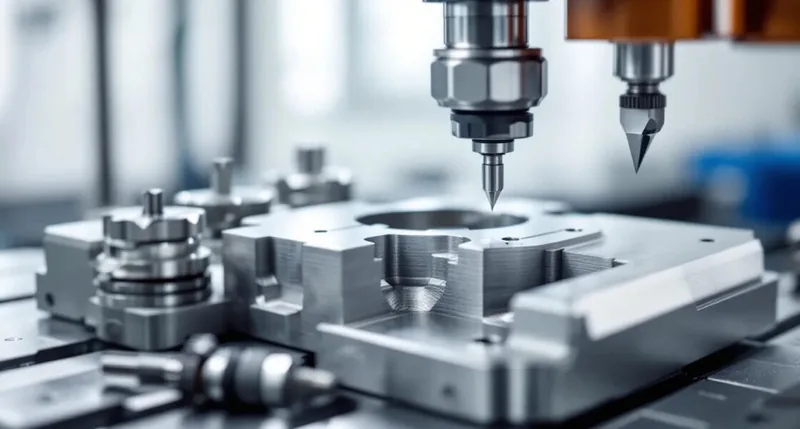
Precision in manufacturing has always been the standard , but laser calibration is now essential to maintain it. What has changed is the margin for error — and in a growing range of industries, that margin is now close to zero. Aerospace tier suppliers must validate tolerances measured in tenths of thousandths. Medical device manufacturers face FDA compliance environments where dimensional accuracy directly affects patient outcomes. Defense contractors work under ITAR-regulated specifications where non-conformance is not a corrective action event — it is a contract disqualification. As reshoring continues pulling more of this high-stakes production back to domestic shops across Pennsylvania, Maryland, Ohio, New Jersey, and West Virginia, the question of whether your CNC machines are actually performing to their rated accuracy has moved well beyond the quality department. It is now an operations survival question.
What Machines Actually Do Over Time
CNC machines drift. That is not a design flaw or a sign of poor equipment — it is the physics of mechanical systems operating under load, temperature variation, and continuous use. Thermal expansion from ambient and spindle temperature changes causes axis positioning errors that are invisible without deliberate measurement. Mechanical wear on ball screws and linear guideways accumulates incrementally, introducing backlash and repeatability variation that shows up as dimensional inconsistency in finished parts. Servo tuning drifts as drive components age. The vibration of production activity on a shared floor transfers forces that gradually affect geometric relationships between axes.
The dangerous characteristic of calibration drift is that it is consistent. A machine producing parts that are consistently 0.0004 inches off nominal will do so shift after shift, part after part, with no alarm, no indicator light, and no obvious sign that anything has changed. The first signal is often a customer quality return, a failed first article inspection, or a pattern of scrap that gets attributed to tooling or material variation before anyone considers the machine itself. By the time the root cause is identified, the shop has absorbed the cost of bad parts, rework, expedited shipping, and a corrective action response to a customer who is now questioning the supplier’s quality system.
A review of precision laser measurement services and optical metrology techniques in advanced manufacturing, published through NIH’s open-access PubMed Central in late 2025, documents how the precision demands of modern production environments have pushed measurement requirements beyond what conventional contact-based inspection can address. Laser interferometry — the technology at the core of NIST-traceable laser calibration systems — is identified as a primary enabler for the ultra-high precision positioning verification that advanced manufacturing now routinely requires across all critical axes.
What Laser Calibration Actually Measures
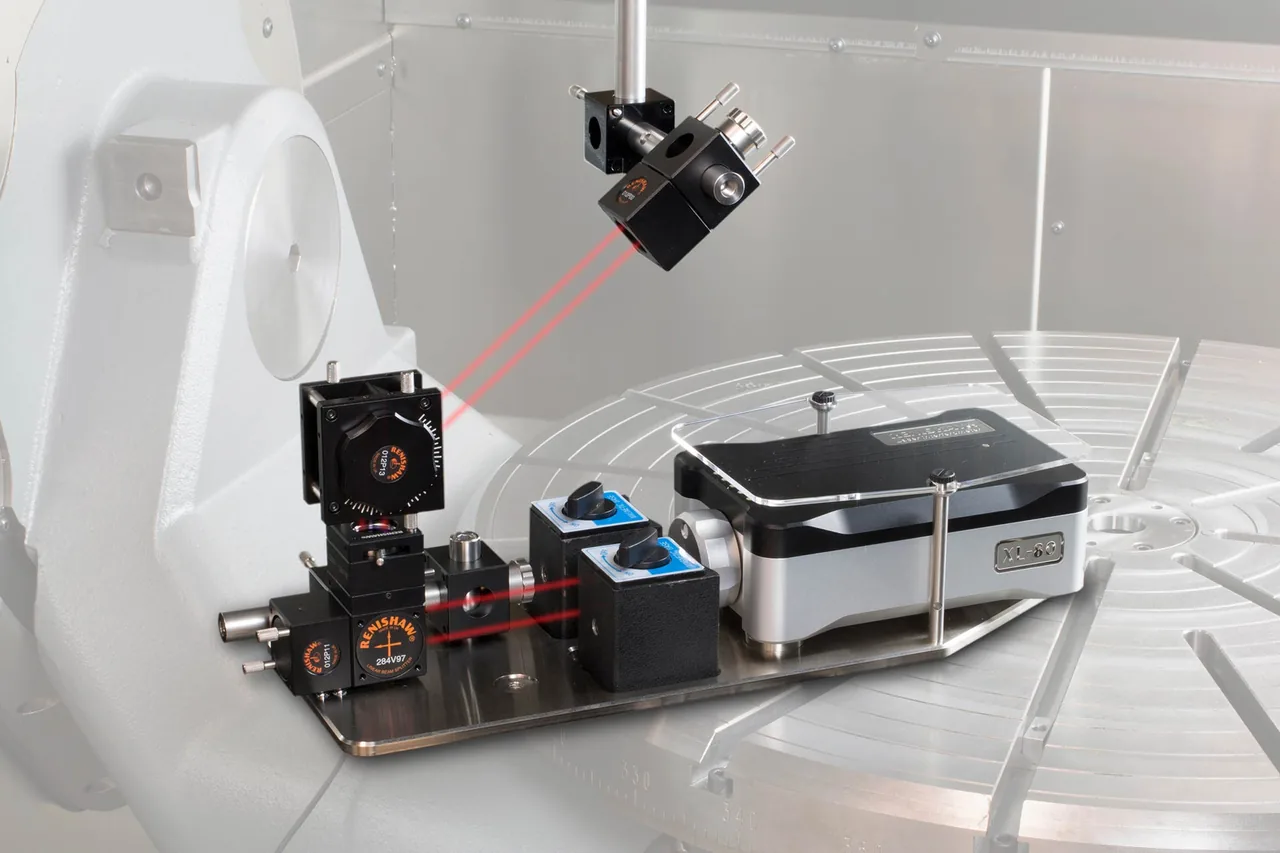
A comprehensive machine tool laser calibration event covers far more than checking whether a machine moves the distance its controller thinks it does. Using laser interferometry, a trained technician measures linear positioning accuracy across the full travel of each axis, capturing thousands of data points at precision reaching 1.0 part per million — one millionth of an inch per inch of travel. Repeatability is measured in both forward and reverse directions to characterize backlash. Straightness errors are quantified to identify guideway wear or thermal distortion. Squareness between axes is verified to detect the kind of perpendicularity error that causes tapered bores or non-square features even when individual axis motion appears correct.
All measurements are traceable to NIST and international standards. That traceability is not a formality — it is the chain of accountability that makes machine tool calibration data meaningful in a quality system, auditable by a customer, and defensible in the event of a nonconformance dispute. A machine with a calibration report showing NIST-traceable results has documented evidence of its capability. A machine without that documentation has assumptions.
The calibration process also generates compensation data. Modern CNC controls can accept error maps derived from calibration measurements and use them to correct for known positioning deviations in real time, effectively restoring a worn or thermally drifted machine to positional accuracy it would not achieve without correction. That capability extends the productive service life of equipment and defers capital replacement decisions that become necessary much earlier when machines are allowed to drift without measurement or correction.
For shops currently investing in new or quality used equipment, Record Machine Tool Orders Signal a Capital Equipment Surge — and a Used Market Boom provides context on the current acquisition environment — and underscores why any machine entering service, whether new or used, should be calibrated immediately after installation to verify it actually meets the specifications it was purchased against.
The Compliance and Customer Requirements Driving Adoption
For many regional shops, the question of calibration frequency has already been answered by their customers before internal quality systems required it. AS9100-registered aerospace suppliers treat machine calibration as a production prerequisite with documented intervals and controlled records. ISO 9001-certified shops include calibration schedules as part of their controlled maintenance plans, with objective evidence required during surveillance audits. Automotive suppliers under IATF 16949 frameworks carry similar requirements. Medical device manufacturers operating under 21 CFR Part 820 quality system regulations have long treated equipment calibration as a mandatory controlled activity with full traceability requirements.
American Machinist’s coverage of calibration machine tools standards and methods confirms that major airframe manufacturers now routinely require volumetric error mapping — full three-dimensional characterization of machine accuracy across the working envelope — as a condition of supplier qualification for critical structure work. That requirement, once confined to the largest aerospace primes, is propagating down through supply chains to tier 2 and tier 3 shops that a decade ago would not have considered it standard operating practice.
Shops competing for this work without documented CNC calibration services are not competitive on quality grounds regardless of their pricing. The certification requirements are non-negotiable, and auditors are specifically trained to identify gaps in equipment calibration records. A single finding on calibration documentation during a customer audit can freeze a supplier qualification process and delay or eliminate contract awards that the shop otherwise had the capability to win.
When Calibration Events Are Required
Establishing a calibration interval depends on the precision of the work being produced, the volume of production running through the machine, and the environmental conditions of the facility. High-precision shops producing aerospace or medical components typically calibrate key machines every six months. General-purpose production environments may calibrate annually with confidence. High-volume facilities running machines on three shifts may require quarterly checks to stay ahead of wear-driven drift.
Beyond scheduled intervals, specific events should always trigger an out-of-cycle calibration. Machine relocation — even moving a machine across the same facility — introduces leveling changes and stress relief that invalidates prior calibration results. Major repairs to spindles, ball screws, or guideways change the geometric relationships between components. Collision events, regardless of apparent severity, can shift axis alignment in ways not visible without measurement. And any sustained pattern of parts falling outside tolerance that cannot be attributed to tooling, fixturing, or material variation points toward the machine itself.
New equipment installation — whether brand-new machinery or quality used equipment entering service — deserves immediate calibration to establish a verified baseline. It is the only way to confirm that the machine performs as specified, that shipping or installation introduced no damage, and that the warranty or operational period is being measured from a state of documented accuracy rather than assumed accuracy.
The staffing dimension of calibration service is also worth acknowledging directly. The shortage of qualified technical personnel detailed in America’s CNC Staffing Crisis Is Hitting Pennsylvania Manufacturers Hard affects the availability of field service technicians who can perform calibration correctly and interpret results with enough understanding of the machine system to recommend corrective action. Working with a regional provider who combines CNC calibration suppliers expertise with calibration service capability reduces coordination complexity and ensures the technician understands what the numbers mean in the context of the specific equipment involved.
The Business Case in Plain Terms
The cost of a calibration event is fixed and predictable. The cost of the problems calibration prevents — scrap, rework, customer quality escapes, corrective action reports, re-inspection of suspect batches, and potential contract loss — is not. Shops that maintain regular calibration intervals for critical production equipment consistently demonstrate lower quality costs, more predictable first-pass yield, and stronger performance on customer quality metrics than those that calibrate only in response to problems.
Precision, properly maintained, is a competitive advantage. Left unmanaged, it becomes a liability that compounds silently until the customer finds it first.
Exact Machine Service
Exact Machine Service connects manufacturers with the skilled technical professionals they need to keep operations running. We deliver vetted, qualified talent ready to perform from day one.
Our Services Include:
- Technical Staffing Solutions — CNC field service engineers, automation specialists, machinists, and skilled trades professionals placed nationwide
- Machine Tool Sales & Service — New and used CNC and manual machine tools, field repair, maintenance, and laser calibration across throughout Pennsylvania, Maryland, New Jersey, Ohio, West Virginia and beyond
Ready to Fill Your Open Roles? Contact Exact Machine Service to discuss your staffing needs and get pre-screened technical candidates working in your facility fast.
Works Cited
Sun, Mingyu, et al. “A Review of Optical Metrology Techniques for Advanced Manufacturing Applications.” PMC / PubMed Central, National Institutes of Health, Nov. 2025, pmc.ncbi.nlm.nih.gov/articles/PMC12654731/. Accessed 26 Mar. 2026.
“Machine Tool Calibration: Standards and Methods.” American Machinist, www.americanmachinist.com/cmm-and-qc/article/21894597/machine-tool-calibration-standards-and-methods. Accessed 26 Mar. 2026.