
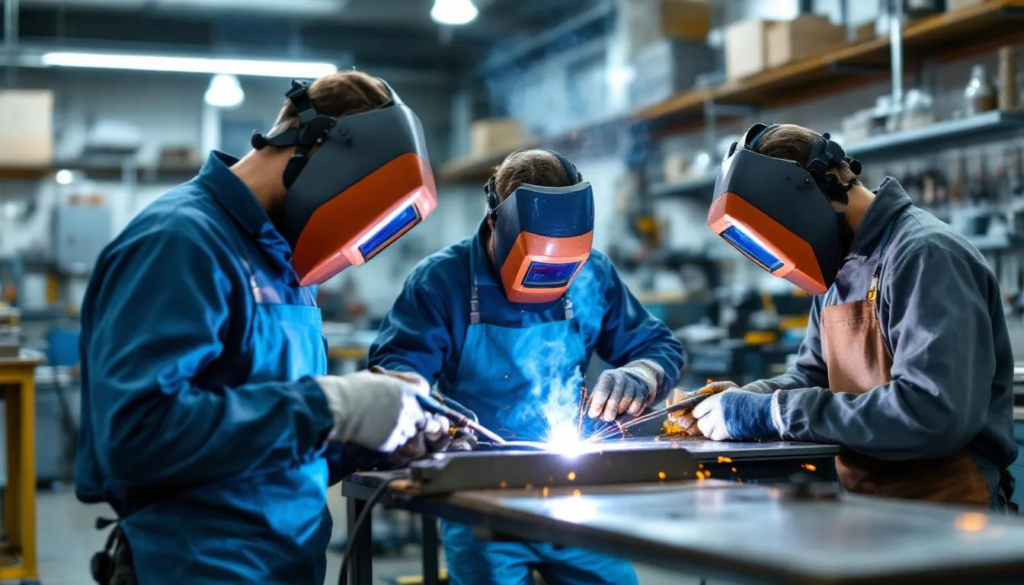
Exact Machine Service: Your Quality Source for Machine Tool Field Repair and Maintenance
The help wanted signs tell a story that extends far beyond individual job openings. Across Pennsylvania’s manufacturing corridor, from the precision shops of York County to the production facilities surrounding Harrisburg, manufacturers are confronting a reality that threatens their operational foundations: the people who know how to fix the machines are becoming increasingly scarce.
According to the Manufacturing Skills Institute’s analysis of Federal Reserve data on unfilled manufacturing positions, approximately 449,000 U.S. manufacturing jobs remained unfilled as of early 2025. While this represents a decline from the pandemic-era peak of nearly one million open positions, it still vastly exceeds the pre-pandemic average and indicates a structural rather than cyclical shortage. The positions proving most difficult to fill include machine operators, maintenance technicians, and CNC machinists, the very roles upon which production depends.
The mathematics of skilled trades workforce development explain why this shortage persists despite strong wages and stable employment. Maintenance and repair workers face nearly four job openings for every qualified graduate emerging from training programs. CNC machinists see approximately 2.4 openings per graduate. These ratios mean the shortage cannot be solved simply by training more workers, though that remains essential for long-term improvement.
The Knowledge Drain Accelerating
Pennsylvania’s manufacturing workforce skews older than the overall labor market. Twenty-six percent of the national manufacturing workforce is age 55 or older, representing 3.9 million workers approaching retirement. Each departure removes not just labor capacity but accumulated knowledge that took decades to develop.
Consider the veteran machine tool service technician who has spent 30 years diagnosing CNC equipment. That individual knows which error codes indicate serious problems versus nuisance alarms. They recognize the sound of a spindle bearing beginning to fail months before instruments would detect the problem. They understand the quirks of legacy equipment that documentation never captured. When that person retires, their knowledge leaves with them.
Training replacements takes years, not months. CNC troubleshooting combines electrical theory, mechanical principles, control system programming, and hands-on diagnostic skills that require extensive practical experience to develop. A technician completing formal training still needs years of field experience before approaching the capability of the veterans they replace. The operational implications explored in The Critical State of Machine Tool Maintenance in Pennsylvania Manufacturing demonstrate why this knowledge gap creates real production risks.
How Manufacturers Are Adapting
Pennsylvania manufacturers are pursuing multiple strategies to address skilled trades constraints. Some are investing heavily in internal training, creating apprenticeship programs and partnering with community colleges to develop their own talent pipelines. These long-term investments make sense for larger organizations with the resources and scale to support formal development programs.
Smaller and mid-sized manufacturers, who constitute the majority of Pennsylvania’s manufacturing base, face greater challenges. They lack the volume to support dedicated training programs and cannot afford to have apprentices learning on production equipment needed for customer orders. These organizations increasingly rely on external partnerships with specialized service providers who maintain the technical expertise that individual facilities cannot develop internally.
Technology investments offer partial solutions. Monitoring systems that provide early warning of developing equipment problems reduce the urgency of emergency responses. Remote diagnostic capabilities allow expert technicians to assess situations before traveling to facilities, improving first-visit repair rates. Simplified equipment interfaces reduce the expertise required for routine operations while concentrating technical demands where specialized knowledge truly adds value.
The Service Provider Evolution
Machine tool service providers are evolving their business models in response to workforce constraints. Where service once meant dispatching technicians to repair breakdowns, leading providers now offer comprehensive maintenance programs designed to prevent emergencies rather than simply respond to them.
These programs include scheduled inspections, calibration services, and preventive replacements that keep equipment operating reliably. By spreading maintenance across planned activities, they reduce the demand for emergency response while improving overall equipment reliability. Manufacturers gain predictable maintenance costs and improved uptime while service providers gain sustainable business relationships that support investment in workforce development.
The economics increasingly favor these partnership arrangements. Contract maintenance agreements cost less than the sum of individual emergency service calls while delivering better equipment performance. Technicians working within established maintenance relationships develop deep familiarity with specific equipment, enabling faster diagnoses and more effective repairs. Understanding The True Cost of CNC Machine Downtime: Why Pennsylvania Manufacturers Are Investing in Preventive Maintenance clarifies the financial logic driving this evolution.
Building for the Future
The skilled trades shortage will not resolve quickly. Demographic trends ensure that retirements will continue outpacing new workforce entries for years to come. Manufacturers who recognize this reality and adapt their strategies accordingly will outperform those who hope the labor market will somehow correct itself.
Successful adaptation requires treating maintenance expertise as a strategic resource to be developed and preserved rather than a commodity to be purchased as needed. This means documenting equipment-specific knowledge so it survives personnel changes. It means building relationships with service providers who invest in their own workforce development. It means embracing technologies that extend the reach of available expertise.
Pennsylvania manufacturing’s future depends on maintaining the production equipment that generates output and employment. With fewer skilled technicians available to service that equipment, every maintenance relationship becomes more valuable. Manufacturers who invest now in building those relationships position themselves to maintain production capability even as workforce constraints intensify.
The Regional Advantage
Pennsylvania manufacturers benefit from geographic concentration that supports specialized service infrastructure. Research published by Area Development on manufacturing workforce challenges notes that workforce risk has become a location strategy driver, with corporate occupiers prioritizing regions with strong training pipelines and service capabilities. The density of manufacturing operations across South Central Pennsylvania creates sufficient demand to sustain service providers who maintain deep expertise across multiple equipment types and manufacturers.
This concentration creates opportunities for knowledge sharing and workforce development that more isolated manufacturing regions cannot match. Technicians working across diverse facilities develop broader experience than those serving single operations. Service providers can justify investments in training and equipment that would be uneconomical serving smaller markets.
Manufacturers who leverage this regional infrastructure gain access to capabilities they could not maintain internally. Emergency response times improve when qualified technicians operate nearby. Specialized equipment for laser alignment, vibration analysis, and other diagnostic procedures becomes available through service relationships rather than requiring capital investment in seldom-used tools.
Exact Machine Service: Your Partner in Production Excellence
At Exact Machine Service, we understand that finding qualified technicians is harder than ever. That’s why we’ve invested over 20 years in developing a team with deep expertise across every major CNC platform, ready to support Pennsylvania manufacturers who need reliable maintenance without the challenge of building internal technical staff.
Our Services Include:
- On-Site Machine Tool Repair – Expert technicians with 25+ years of experience servicing all major CNC control brands including Fanuc, Siemens, Haas, and Mazak
- Machine Tool Sales – New and used equipment sales backed by the service expertise to keep your machines running
Ready to Partner with Experienced Technicians? Contact Exact Machine Service today to discuss how our team can extend your maintenance capabilities without the challenge of finding and training technical staff.
Works Cited
“Open Jobs Are Piling Up—Is U.S. Manufacturing Ready for the Next Surge?” Manufacturing Skills Institute, 19 May 2025, manufacturingskillsinstitute.org/next-job-surge/. Accessed 2 Feb. 2026.
“The Workforce Bottleneck in America’s Manufacturing Revival.” Area Development, Q4 2025, www.areadevelopment.com/skilled-workforce-STEM/q4-2025/the-workforce-bottleneck-in-americas-manufacturing-revival.shtml. Accessed 2 Feb. 2026.
Related Articles
- The Critical State of Machine Tool Maintenance in Pennsylvania Manufacturing
- The True Cost of CNC Machine Downtime: Why Pennsylvania Manufacturers Are Investing in Preventive Maintenance